The Single-Story Town: Why One Film Cannot Speak for a Region
A single film can make a region vivid, but it cannot contain it. Learn to notice whose voices, places and rhythms remain outside the frame.

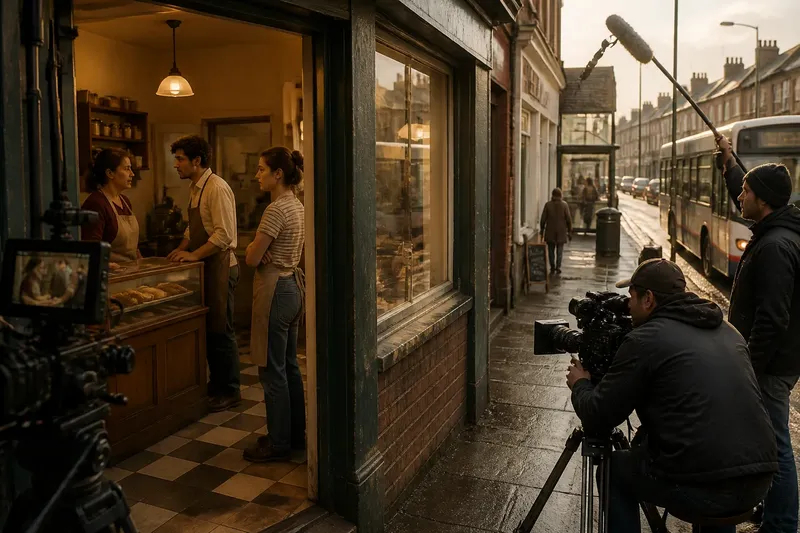
A bus pulls away from a wet high street; a shopkeeper lowers the shutters, and the last customer hurries for the stop. A film can make that street feel like a town, but its regional portrait comes from one particular arrangement of people, places and moods. To see what the frame leaves out, look beyond its most memorable image.
Whose town is it?
A film’s point of view often belongs to a particular character, family or social circle. Their route through town may pass the takeaway, the football ground and a relative’s front room, while another resident’s everyday map includes a mosque, a market stall or a factory gate. Neither map is the region in full.
Notice who gets to explain local customs and who is expected to understand them without comment. Does a newcomer ask the questions? Does a long-established resident appear only to deliver local wisdom? Those choices shape whose experience seems ordinary and whose is treated as colourful background.
Say a fictional drama follows a teenager whose family runs a bakery near the station. Early deliveries and school journeys make the character’s route familiar, but that close knowledge tells us little about life beyond it. Keep the viewpoint in mind as the story makes its claims.
Follow the edges
Regional identity can gather around familiar settings: a market square, a harbour, a housing estate, a village pub. These locations help a story feel grounded, yet repeated attention can make one corner seem like the whole place. Ask what lies just outside the scene: neighbouring districts, new developments, rural edges or the roads people use to travel between them.
Look at transitions. If a character moves from a crowded centre to a quiet hillside, does the film present the journey as a change of world or a routine trip? A regional boundary may be a council line, but it can also be a shift in accent, transport, work or social connection. The edges a film chooses tell you which distinctions it considers meaningful.
Ask which part of the map the story makes visible, and which part stays off-screen.
Listen for mixed voices
Accent can signal place, but no town speaks with one voice. People may use local expressions in one setting and more formal speech in another; families, workplaces and generations can have distinct rhythms. A film that gives every local character the same cadence may be building a clear soundscape, not recording every voice in the region.
Listen for who is allowed to be funny, uncertain, ambitious or quiet. If only one character carries the accent and the jokes, local speech may become a costume. If characters shift register according to whom they address, the story offers a more layered sense of how people move between social worlds.
There is no need to score accents or count them. Notice what the sound of a character’s speech is being asked to tell you.
Notice what feels ordinary
Films often mark regional character through conspicuous details: a local dish, a weathered sign, a familiar chant from the terraces. Such details can matter, but they can also turn a place into a display. Quieter evidence may be more revealing: how long a neighbour stays at the door, which bus people expect to miss, or how a room changes when a visitor arrives.
Pay attention to what the film does not explain. A character’s shorthand reference to a local road or school can suggest shared knowledge among residents. A scene that pauses to explain every custom may instead address an audience assumed to live elsewhere. Neither choice is wrong; each tells you something about the imagined viewer and the local knowledge the film values.
Separate a striking local detail from a claim that everyone there shares it.
Questions about film portraits?
What is missing from a film about a town?
Look for people, workplaces or routes that the story never needs to encounter. Their absence does not prove deliberate exclusion, but it limits the picture the film can offer.
Does a local accent make a portrayal authentic?
It can help a character sound situated, but authenticity depends on more than pronunciation. Relationships, speech habits and the character’s point of view matter too.
Why do some locations recur on screen?
A recognisable street or landmark gives viewers a quick sense of place. Repetition can make that image powerful while leaving less visible parts of the region unexplored.
Can one film still say something useful about a region?
Yes, if you treat it as a particular account rather than a complete portrait. Its choices can show what one story finds compelling, familiar or difficult to see.
Hold the image lightly
Instead of deciding whether a film gets a region right, ask what kind of account it offers. Is it a family story, a workplace drama, a comedy built around local speech, or a tale of someone leaving? Each form brings certain details forward and lets others recede. Its limits are part of its meaning.
Imagine an invented film set in a coastal town, following a cook on late shifts at a hotel. The harbour appears only on the walk home, while the story stays mostly in staff kitchens and shared flats. That choice makes hotel workers’ routines visible; it does not make their experience the town’s universal one.
Comparisons can sharpen this reading. Put two films set in the same region beside each other, even if one is a comedy and the other a family drama. Notice whether they return to the same streets, use different kinds of local speech or give attention to different generations. The contrast reveals variation without asking either film to serve as the definitive version.
A single film cannot speak for a whole region, but it can make one corner newly legible. When considering a film’s portrait of a town, keep its boundaries clear: ask who is speaking, where their story reaches and what other lives might occupy the frame. That is a more generous way to watch a place than asking one story to contain it.