Studio Set or Real Location: What Each Gives a Local Story
Studio set or real location: compare control, texture and local detail to choose a production approach that serves your story and its sense of place.
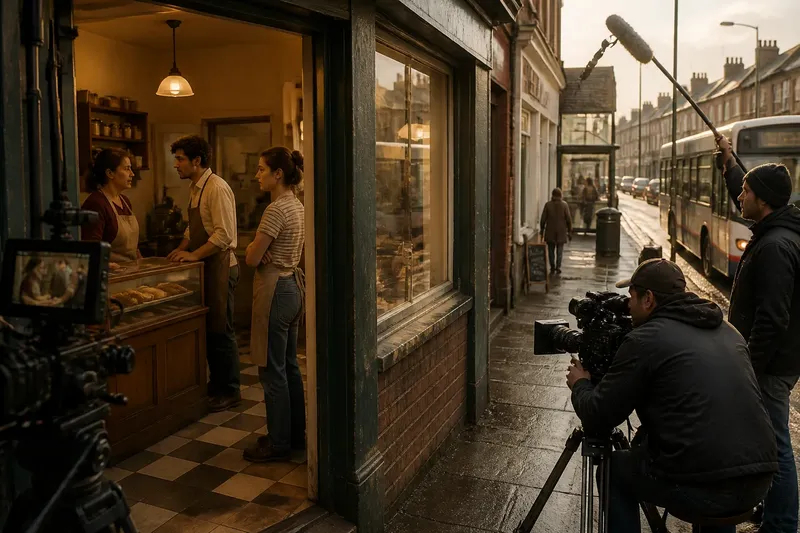
Rain begins as an actor reaches the corner shop, and the scene needs another take. On a studio set, the crew can reset the pavement and hold the lighting. On a real street, a passing bus, wet brickwork and the shop’s daily routine may shape the moment. Choosing a studio set or real location changes not only how a film is made, but how its neighbourhood appears on screen.
A set offers control and consistency. A real location carries existing surfaces, weather and signs of everyday use. A hybrid approach can draw on both. The right choice depends on what the story needs the place to contribute.
Control on set
A constructed environment lets the crew decide where a door sits, how far a kitchen extends and what can be seen through a window. That control helps when a scene depends on precise movement: a character crosses a cramped room, hides something beneath a loose floorboard, then turns towards an entrance on cue. A real house may not provide the necessary space or sightlines.
Sound and light can be managed, too. A soundstage can keep traffic and neighbouring machinery outside the scene. Lighting equipment can stay in place between takes, while walls can be moved or removed to make room for cameras. For a local story with repeated interior scenes, a set can offer a consistent version of a recognisable space.
There is a trade-off. A set represents a place through production choices. Worn wallpaper, a narrow hall or a shop counter can suggest a particular neighbourhood, but those details are designed rather than accumulated through ordinary use. Scuffs and patched paint may look convincing; their meaning still comes from the filmmakers’ interpretation.
Choose a set when a scene needs repeatable conditions, exact blocking or an interior that cannot be altered safely or practically. It is especially useful when the room’s layout drives the action.
Texture on location
A real location arrives with details that can be difficult to recreate: a corner shop’s worn threshold, a slope in the pavement, a view between buildings or the way a local bus turns into a narrow road. These are more than backdrops. They can make a character’s route feel habitual and connect a scene to a particular kind of place.
Location work also brings the area’s conditions into production. Daylight changes, weather moves through and passers-by may alter a take’s rhythm. A nearby road can colour the sound. Shop stock and street signs can suggest how people use a space without a character having to explain it.
Those qualities are not always useful. A location may be too noisy for dialogue, too small for a camera position or unavailable when the scene needs filming. A busy frontage can make a quiet exchange difficult. The production may need permission, access arrangements and a plan for matching scenes filmed in different conditions. A real setting still needs careful shaping for the camera.
Choose a real location when the story depends on an existing street, shop, room or landscape, and its visible details matter more than complete control. It works well when the place should feel inhabited rather than arranged solely for filming.
Hybrid production
A third option combines location and construction. A production might film the exterior of a real community hall, then build an interior that matches its entrance and local character. Or it might use an actual shopfront for establishing shots while recreating the counter and shelves on a stage. The exterior can establish a real place; the constructed interior can give the crew more room or control.
This approach requires continuity. Door positions, window views, paint colours and the direction of light should feel compatible when the scene moves from the real exterior to the built interior. If those details clash, the transition can make the place feel generic or inconsistent.
Hybrid production suits stories that need a recognisable local presence alongside demanding interior scenes. It can also help when a location has a strong exterior but cannot support the camera, sound or access needs of a full sequence. Decide which qualities must come from the real place and which can be built.
Matching method to story
Start with the setting’s role, not the convenience of the shooting plan. Ask what a viewer needs to notice and what a character needs to do there. If a story turns on a narrow staircase, its actual shape may be essential. If a scene needs a wall to disappear for a camera move, a set may be clearer.
- Blocking: If actors, camera and props need to repeat tightly arranged movements, choose a set; otherwise, assess whether the location’s layout supports the action.
- Local detail: If surfaces, street patterns or established views carry meaning, use the location; if they do not, recreate only the details the scene needs.
- Sound: If dialogue must remain quiet and clear, consider a controlled interior; if street sound belongs in the scene, record at the location and plan around its activity.
- Continuity: If changing light or weather would disrupt matched scenes, use a controlled environment; otherwise, schedule around conditions the production can manage.
- Essential features: If a room’s shape or a street’s view makes the story specific, preserve it on location or reproduce it carefully; if a detail is merely decorative, leave it out.
- Access and alteration: If a site cannot accommodate the crew or filming would disrupt its users, build or find another location; if access is workable, agree arrangements with those who use the space.
Say a film centres on a family-run bakery whose cramped counter forces relatives to pass one another sideways. The production first identifies the real frontage as essential because it sits among familiar local shops. It then checks that the interior cannot provide the camera space needed for an argument. The crew films the exterior and builds a matching counter on a stage, adjusting the layout for close choreography while keeping the window and paint details consistent. The result should connect the bakery to its street while giving the scene room to play.
Place beyond landmarks
A local setting can feel specific without showing a famous landmark. A bus shelter, estate path or back-room window may say more about a character’s routine than a wide view of the town. Protect the detail that matters. A real location is not automatically more truthful, and a set is not automatically artificial: either can make a place feel meaningful or merely decorative.
Consider who uses the space beyond the film. A working shop or shared hall has its own rhythms and relationships. A constructed version can offer creative freedom without asking a functioning local space to absorb the disruption of filming. Treat access and disruption as practical considerations, not as proof of authenticity.
The studio set or real location decision becomes clearer once you name the quality a scene cannot lose. That may be the exact shape of a room or the unplanned grain of a street. Keep that quality visible, and let the production method serve the story’s connection to place.
Questions about locations?
Is a real location always more authentic?
No. A real place brings material detail, but authenticity also depends on how the film observes and uses it. A designed set can feel grounded when its layout and objects serve the characters rather than relying on generic signs of local colour.
When should a scene use a studio set?
A set is useful when a scene needs controlled light, quiet sound, repeatable conditions or a layout designed around precise action. It can also make an interior possible when a real building is too small or unsuitable for filming.
Can one film combine sets and locations?
Yes. A film can use a real exterior and a matched constructed interior, or move between actual streets and built spaces. Consistent windows, doorways and surface colours help the audience understand that both belong to the same place.
How should a production choose between them?
Identify what the setting contributes, then compare that need with the control and access each approach offers. If a distinctive local detail is central, preserve it; if exact staging matters more, build around it.