Before the Multiplex: The Neighbourhood Picture House
The neighbourhood picture house made filmgoing part of local life. Trace how regular visits, familiar faces and shared routines turned a screening into a gathering.
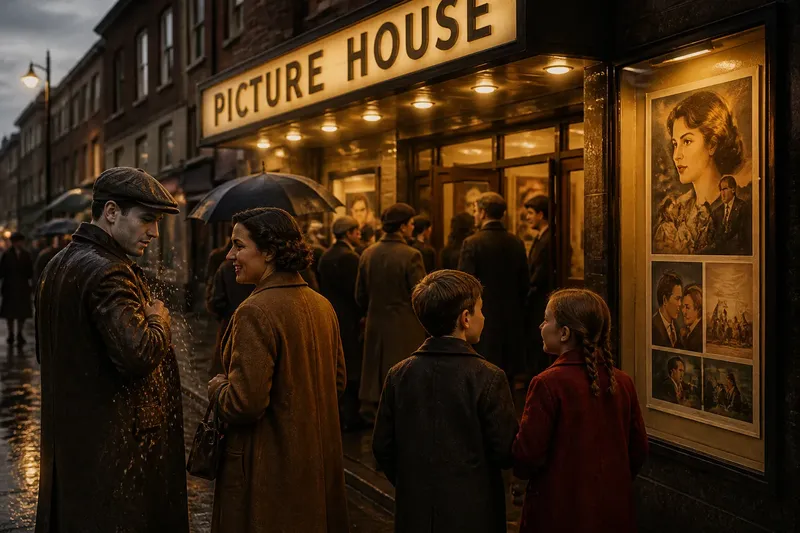
On a wet evening, a queue gathers beneath the picture house sign. Someone shakes rain from a coat; a neighbour pauses to exchange news; children try to guess which seat their family will choose. The neighbourhood picture house was more than a place to watch a film. Its regular rhythms could turn filmgoing into a small, dependable piece of local life.
To understand that role, look beyond the screen. Notice who came, how they met, what they did before and after the show, and which habits returned from week to week. The building mattered as a destination, but its social meaning came from repeated encounters.
Arriving through habit
A local picture house often fitted into an ordinary evening. A family might go after work or errands; friends might meet outside and decide together what to see. The visit began before the lights dimmed, with familiar routes, greetings and the practical business of finding one another.
Regular attendance gave a cinema a place in neighbourhood routine. People could recognise fellow patrons without knowing their names. A nod in the queue or a brief conversation in the foyer made the outing feel connected to the streets outside, rather than separate from them.
Imagine a resident who visits on the same evening each week and usually arrives early. Over time, she begins to recognise a couple who wait by the poster case and a shopkeeper who comes in after closing. The expected result is modest but visible: the evening acquires familiar faces, and a solitary outing can become a shared local ritual.
Look for the repeated patterns, not only the special premieres. Ordinary visits reveal how a venue settled into everyday time.
Meeting beyond the film
The interval, entrance and pavement could all become social spaces. Patrons might discuss the story, exchange local news or simply wait together for the doors to open. These encounters did not need to be deep or organised. Their value lay in making contact easy.
A cinema also brought together people whose daily routines might otherwise overlap only in passing. Neighbours could arrive as families, couples, friendship groups or individuals, then share the same public room. The screen offered a common subject, while the crowd supplied a different kind of company.
That shared setting did not make everyone’s experience identical. A child attending with relatives, a young person meeting friends and an older patron arriving alone might use the same venue in different ways. To describe a picture house as a gathering place, keep those differences in view rather than turning the crowd into one imagined community.
Reading a local evening
A useful way to trace the social setting is to follow one ordinary visit across a week. Start with the days before the screening, when people decide whether to go and whom to invite. Then consider the evening itself, from arrival to departure, and finally ask what might carry into the following days.
- Before the visit: Notice how patrons learned what was showing, such as a poster outside, a local notice or conversation with a friend.
- On arrival: Consider whether people came alone or in groups, and where they might wait or meet.
- During the interval: Look for the small exchanges that made the venue more than a room facing a screen.
- After the show: Ask whether the crowd left together, paused to talk or continued the evening elsewhere.
- In the days after: Trace whether a film became a subject of conversation at work, at home or along familiar streets.
This is not a timetable that every cinema followed. It is a way to notice how public entertainment fitted into local time. A screening could be an occasional treat, a routine appointment or a meeting place arranged around the film.
Who felt at home?
Calling a picture house a community space can conceal the question of access. Who could afford the outing, travel there comfortably, attend at the available times or feel welcome in the room? Answers might differ between generations, social groups and households, even within the same neighbourhood.
Local accounts are most useful when they preserve that variety. A family memory may emphasise a shared treat; another person may remember going alone or rarely attending. Neither account needs to stand for everyone. Together, such recollections can show how a venue was used and where its social reach had limits.
When describing a neighbourhood audience, be precise about the evidence available. A remembered queue suggests company and anticipation; it does not by itself establish who was present or how they felt. Small details can evoke a scene without claiming that every resident belonged to it.
What did the cinema offer?
Was the picture house mainly a place to watch films?
The film was the reason for the screening, but the visit could include meeting others, sharing an outing and following a familiar routine. Those activities made the venue part of local social life without replacing its purpose as a cinema.
Did regular attendance mean everyone knew one another?
Familiarity might amount to recognising faces, not forming friendships. A recurring crowd can create a sense of shared presence while remaining a mix of strangers and acquaintances.
How can local memories describe the audience?
Use recollections to identify concrete habits, such as meeting points or customary companions, and keep each memory attached to its speaker. Avoid turning one person’s account into a claim about an entire neighbourhood.
What remains when the cinema closes?
Memories may preserve routes, meeting customs and conversations as well as films people watched. A careful account can show what the venue meant to particular patrons while acknowledging that memories do not represent every experience.
Keeping the social record
For a local history, record the evening as a sequence of human actions: deciding to go, arranging a meeting, arriving, watching, leaving and talking afterwards. Ask who is being remembered, what detail they recall and whether another voice offers a different view. That approach keeps the picture house grounded in lived routines rather than a vague claim that it brought everyone together.
It also helps distinguish the cinema’s social role from the film’s portrayal of place. The neighbourhood could shape the audience’s evening even when the story on screen belonged somewhere else. A local setting might prompt recognition, but the gathering itself came from people sharing a venue and a recurring occasion.
The neighbourhood picture house is best remembered through those ordinary appointments: the person waited for, the familiar face in the queue, the conversation carried out through the door. Trace those details, and the history of filmgoing becomes a history of how people spent time together in a particular place.